A Little Argument with Larry
On Frustration, Mercy, and The Great Work. An exploration of contradiction, perspective, and the possibility that what appears irreconcilable may be held within a larger structure.
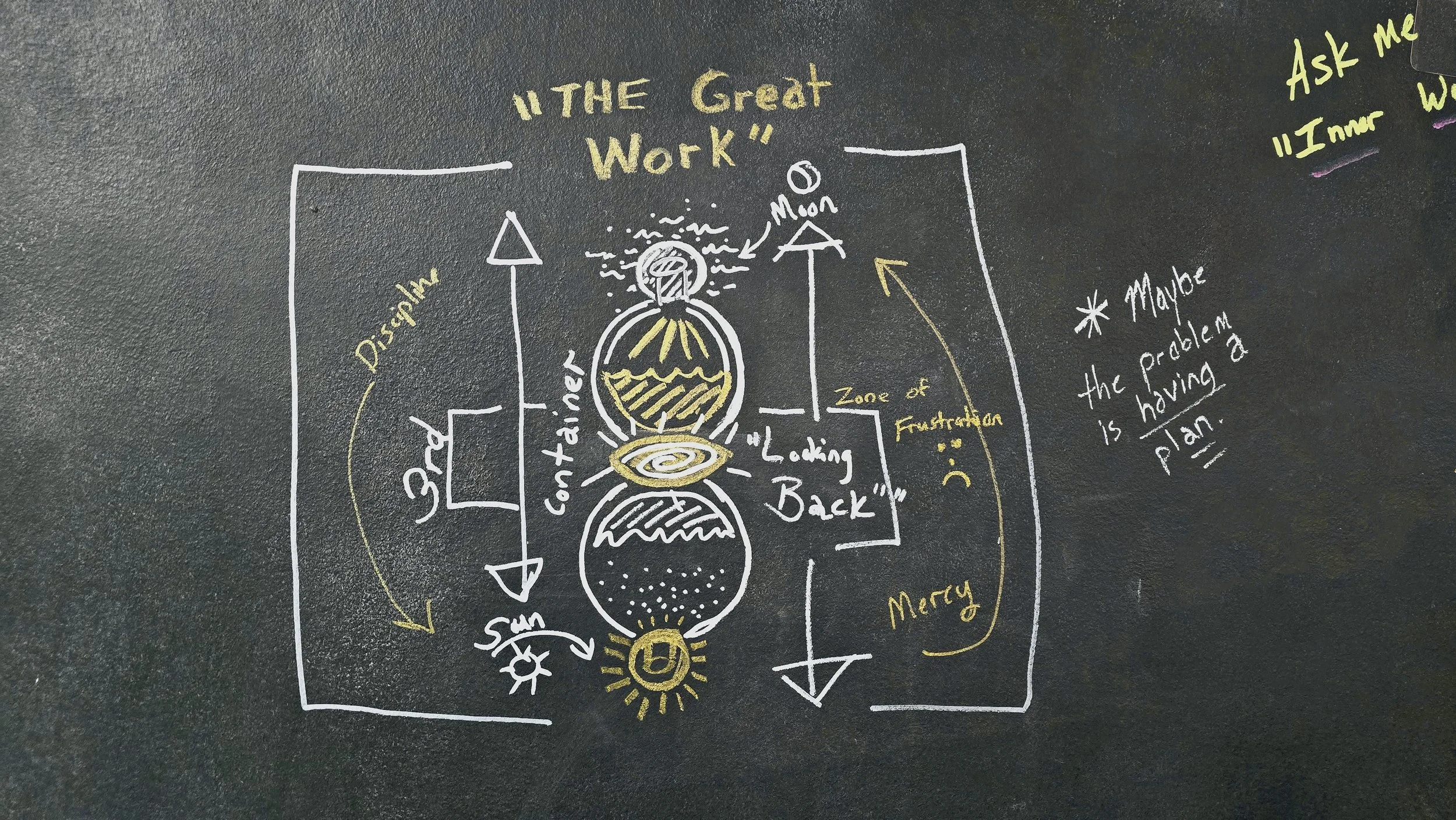
Earlier this week I found myself staring down a familiar storm of internal contradictions, fueled by trivial chaos in the material world and real turbulence from within.
After roughly two weeks of travel, holidays, and disrupted routines, I set out on Monday to reestablish some basic order. That morning, before venturing into the headwind of the laundry room, I asked Larry for just a small amount of mercy. I needed things to work that day, not perfectly, but without added frustration.
What I got instead was a trickster bobby pin.
This tiny pin slipped out of a pocket in the dryer and landed with precision in the lint trap, perched at the edge of the vent opening in such a way that any wrong move would send it into the interior of the machine. I spent an unreasonable amount of time trying to retrieve it from different angles, with different tools and different approaches. Eventually, it fell anyway. Of course it did…
That was the point where I felt the internal winds shift and the storm started intensifying. The reaction was out of proportion to the situation, but it was also very familiar in my nervous system. My resilience tends to disappear when exhaustion meets absurdity. It gets replaced by a much more brutal framework that wants to know why there always seems to be a shortage of mercy in this universe.
“Frustration, contradiction, and a sense of inadequate resources ... It’s what happens when we attempt to manifest something that’s beyond the limits of our current form.”
A few days later, when I sat down to articulate what happened, I could see that the reaction itself was irrational. That did not make it disappear. There is a younger voice that still speaks in those moments, and it speaks in very reasonable shades of rage.
As I was writing, and as the irritation escalated rather than resolved, a three-piece pencil holder at the edge of my desk fell to the floor and scattered its contents.
At that point, I was no longer reacting only to inconvenience. I was trying to determine what, if anything, I was supposed to conclude from patterns like this. It could mean nothing. It could be projection. It could be some vague prompt toward better self-regulation. It could be signaling that Tiffany tends to get a little too “woo” when she’s overwhelmed.
Most days, people pick up the pencils, remind themselves of their blessings, and move on. By my own choice, this was NOT one of those days. This day I chose to fight.
For someone who engages the divine as an active presence—think Jacob and the Angel here—there can sometimes exist a more difficult layer underneath, and it can be a challenge to remain neutral about apparent contradictions. If “Larry” is real and in charge, and if there is an underlying coherence to this universe, then repeated ill-timed frustration raises a legitimate question about the nature of that coherence. Or the intentions of the creator.
While sitting in all this, trying to decide whether to spiral into overthinking, attempt to express this in writing, or just get up and go get a cookie, I realized it had been a while since I’d turned to an intuitive tool. I considered pulling an oracle card, but my deck was upstairs, and I just did not have the capacity to go questing after it.
Then, for whatever reason, I happened to glance back at my desk toward the now empty space where the pencil holder had been sitting. I noticed a box there that contains what I call my “BIG deck.” That’s a box that holds a copy of every card I’ve ever made, even the ones that aren’t currently in my deck.
I used that instead.
I shuffled, pulled a single card, and out of that huge stack, this one emerged. It’s the Work Card (aka “The Great Work”). This card has, over the years, become so significant that it has come to represent the deck itself, and, more broadly, the underlying structure of Mayura. In my own deck, this card best represents the idea of holding the opposites until the transcendent third emerges.
My read of the card was pretty straightforward. Nothing about the frustration or the contradictions I was experiencing really sat outside the work. It was—it IS—the work.
The card also brought to mind the idea of parallax (most thoroughly explored academically by Slavoj Žižek), where an object appears irreconcilably different depending on the position from which it is viewed. The emphasis in that framework is on the gap between perspectives and the impossibility of reducing them to a synthesis. I am less inclined to chase down the philosophical argument here, than to direct myself and the reader to the lived experience it points to.
Whenever we’re identified too strongly with any particular experience, emotion, or thought, its easy to build a case (even a solid one) against the competence or the “goodness” of Larry. That is to say, against the existence of an intelligent agent in the universe that takes a personal interest in human consciousness. But, if we pull that perspective back a little and look at our experiences across time, we quickly find that there’s evidence to build a case in favor of … for argument’s sake, let’s just call it: “The Well-Intentioned Larry.”
However, (to vastly over-simply things) the fact that both positions can be observed and both cases argued, that the space between them can be recognized, suggests the presence of a larger frame that contains them both. And that their totality, complete with its apparent contradictions, itself constitutes a synthesis.
It’s THAT friction, that principle, that this card represents, and it’s that approach that has been encoded into my own work as a result. It does not effectively re-frame the bobby pin or the fallen pencils as pleasant or desirable (or more importantly, balance the scales on greater human suffering). Nor does it prevent the periodic crisis of faith. It does, however, place those experiences inside a process that is consistent with the path I claim to be on.
There is an implication in that recognition that is difficult to avoid. Asking for relief from the conditions of the work does not guarantee the option to step outside of them. The conditions themselves may be the mechanism through which the work proceeds.
I do not find that conclusion especially comforting. (In fact, I find it rather rude on Larry’s part. 🤣) What it does provide is a clear reminder of what it means to attempt to hold opposing realities at once.
Frustration, contradiction, and a sense of inadequate resources. Those are all evidence of being a container in conditions that always demand we carry just a little more than our current capacity. It’s what happens when we attempt to manifest something that’s beyond the limits of our current form.
If we look only at the contradictions themselves, they must remain irreconcilable. But if we look at the fact that we are capable of holding them, observing them, and moving between them, then we ourselves become evidence for the possibility of synthesis and transcendence.
A possibility becoming is quite different than a work completed, however, and that (sometimes inconveniently) demands we examine the balance between mercy and discipline. And that’s, yes … frustrating.